For decades, the skyscraper has stood as the ultimate symbol of urban ambition and economic power. These glittering towers of steel and glass define our city skylines, but they also represent a significant portion of global energy consumption and carbon emissions. The quest for sustainable skyscrapers has primarily focused on reducing their energy appetite through better insulation, efficient lighting, and solar panels. However, a groundbreaking new paradigm is emerging, one that transforms these towering structures from passive consumers into active, dynamic generators of clean energy. The latest architectural breakthrough lies not just in saving energy, but in harvesting it directly from the most abundant resource available at such heights: the wind. This is not merely an incremental improvement; it is a fundamental reimagining of the skyscraper’s role in the urban ecosystem.
The concept of wind-harvesting architecture is evolving from a theoretical fantasy into a tangible reality, promising a future where our tallest buildings can power themselves and contribute surplus energy to the city grid. This in-depth exploration will dissect this architectural revolution, examining the engineering marvels, the economic viability, and the profound implications for the future of urban living.
A. The Unsustainable Legacy of the Traditional Skyscraper
To fully appreciate the wind-harvesting skyscraper breakthrough, one must first understand the environmental burden of conventional high-rise buildings.
A. The Energy Gluttons of the Urban Landscape:
Modern skyscrapers are incredibly energy-intensive. Their sheer scale demands massive amounts of electricity for heating, ventilation, and air conditioning (HVAC) systems to maintain comfortable temperatures across hundreds of thousands of square feet. Lighting, elevators, and the power requirements of hundreds of offices and apartments compound this demand. Traditionally, this energy is drawn almost exclusively from the fossil fuel-powered grid, making these iconic structures indirect contributors to greenhouse gas emissions and climate change.
B. The Limitations of Current Green Solutions:
The green building movement has made valiant strides in mitigating this impact. The LEED (Leadership in Energy and Environmental Design) certification system has pushed architects and developers towards more sustainable practices. However, many of these solutions have inherent limitations, especially when applied to megastructures.
-
Solar Panels: While excellent for low-rise buildings with large roof areas, the roof of a skyscraper is minuscule compared to its total facade area. Furthermore, shading from adjacent buildings, pollution accumulation, and non-optimal angles often limit their efficiency in dense urban cores.
-
Energy Efficiency: Techniques like double-skin facades, high-performance glazing, and motion-sensor lighting are crucial, but they are fundamentally defensive strategies. They reduce the energy drain but do not address the core issue of generation. A building that is 50% more efficient is still 100% dependent on the external grid.
This is where the wind-harvesting skyscraper presents a paradigm shift. Instead of just reducing its draw on the system, it actively injects clean energy back into it.
B. The Architectural Breakdown: Engineering a Building That Breathes Energy
The core of this breakthrough lies in moving beyond simply bolting turbines onto a roof. It involves a holistic, integrated design philosophy where the very form and structure of the building are optimized for energy capture. Let’s deconstruct the key architectural and engineering principles.
A. Aerodynamic Form-Finding:
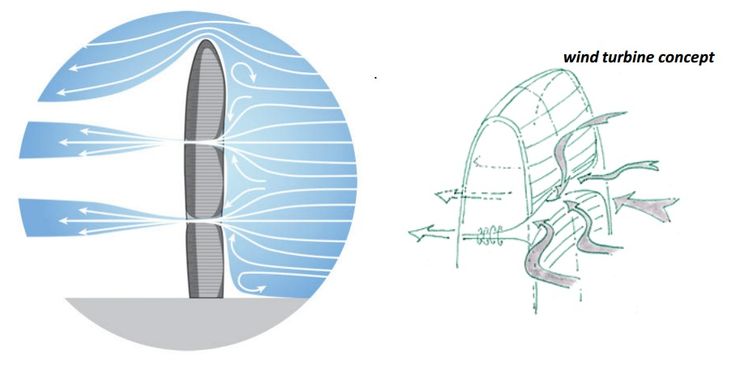
The first and most critical step is rethinking the building’s shape. Traditional rectangular skyscrapers are notoriously bad in the wind. They create massive vortices and downwash, leading to sway that must be mitigated by dampers. The new generation of wind-harvesting towers turns this problem into a solution.
-
Twisting Torsion: By introducing a gradual twist to the building’s form, architects can channel wind smoothly up and around the structure. This not only reduces structural stress and the need for heavy damping systems but also accelerates wind speed through certain areas, much like a wing, creating ideal conditions for power generation.
-
Tapered and Sculpted Profiles: Many new designs feature a tapered form that is wider at the base and narrower at the top, or vice versa. This sculpting helps break up wind patterns and, when combined with strategically placed openings, can funnel wind directly into integrated turbines.
-
Venturi Effect Integration: This is a key principle of fluid dynamics. By designing narrow passages within the building’s form, the wind is forced to accelerate as it passes through. This increased velocity significantly boosts the power output of any turbines placed within these channels, making them far more efficient than freestanding turbines in open wind.
B. The Turbine Technology Revolution:
You cannot simply install traditional, propeller-style horizontal-axis wind turbines (HAWTs) on a skyscraper. They are noisy, prone to vibration, and can be dangerous to wildlife. The breakthrough relies on advanced turbine technology designed specifically for the urban environment.
-
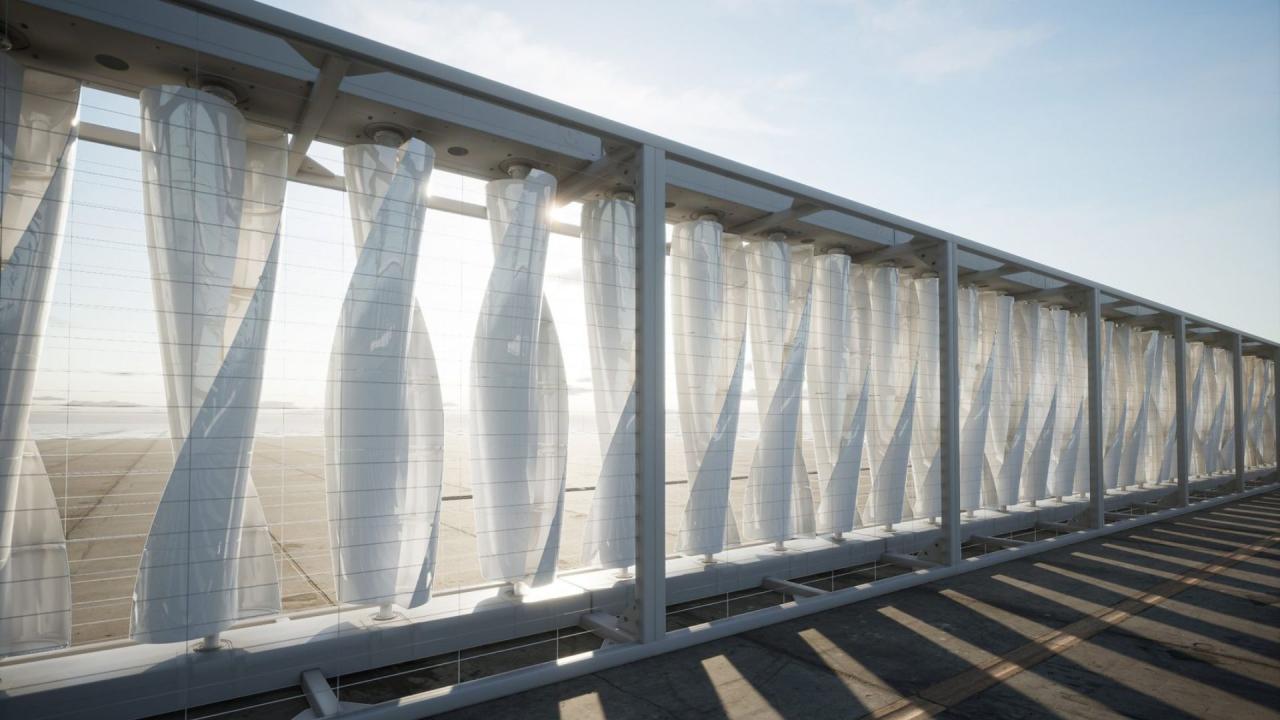
Vertical-Axis Wind Turbines (VAWTs): These turbines, which rotate around a vertical axis, are the heroes of this new architecture. They are omnidirectional, meaning they can capture wind from any direction without needing to reorient themselves a crucial feature for the turbulent and shifting winds in a city. They are also typically quieter, safer for birds, and can be integrated directly into the building’s facade or structural core.
-
Building-Integrated Wind Turbines (BIWT): This is the concept of making the turbine a fundamental part of the building’s skin or structure. Imagine the spaces between floors, or the mechanical gaps in a building’s crown, being lined with arrays of small, efficient VAWTs. This turns the entire facade into a distributed energy generator.
-
Silent and Vibration-Free Designs: New magnetic levitation (maglev) bearings and advanced composite materials are reducing friction and noise to negligible levels, addressing the primary concerns of occupants regarding comfort and livability.
C. Structural Synergy:
Perhaps the most elegant aspect of this design philosophy is the synergy between energy generation and structural integrity. The same openings and channels designed to harness the wind also reduce the building’s wind load. This means the structure can potentially be built with less steel and concrete, saving on both material costs and embodied carbon the carbon dioxide emitted during the manufacturing and construction process. The energy-generating elements become a multi-functional system, serving as both power plant and passive structural stabilizer.
C. Case Study in the Sky: The Bahrain World Trade Center and Beyond
While the fully integrated “wind-scraper” is still emerging, several pioneering buildings have demonstrated the concept’s viability and paved the way for future developments.
A. The Bahrain World Trade Center (BWTC): A Proof of Concept
Completed in 2008, the BWTC is often hailed as the first large-scale building to integrate wind turbines into its design. The two sail-shaped towers are connected by three skybridges, each holding a massive 29-meter diameter horizontal-axis wind turbine. The towers themselves are aerodynamically shaped to funnel the onshore Persian Gulf breeze directly into the turbines. This design provides approximately 11-15% of the towers’ total energy needs, proving that the concept could work on a commercial scale and inspiring a generation of architects.
B. The Strata SE1, London: Urban Integration
The Strata Tower in London is a more direct, if less elegant, application. It features three 19-kilowatt turbines embedded in its crown, designed to power the building’s common areas. While its energy output is more modest, it demonstrated the feasibility of integrating generation technology into a dense urban fabric, navigating planning permissions and technical challenges.
C. Conceptual Marvels: Pushing the Boundaries
This is where the true breakthrough is happening. Firms like SOM (Skidmore, Owings & Merrill) and Arup have unveiled visionary concepts that take integration to a new level.
-
The “Windstalk” Concept: Imagine a building that sways gently, with its entire facade covered in thousands of small, piezoelectric flippers that generate electricity from the slightest breeze, mimicking the motion of grass or reeds.
-
The Perforated Skyscraper: Concepts are being developed where the entire upper section of a tower is a large, sculptural opening, containing a multi-story vertical-axis wind turbine. This isn’t a turbine on the building; the building is the turbine’s housing.
These concepts show a future where the distinction between machine and architecture becomes beautifully blurred.
D. Overcoming the Tempest: Challenges and Economic Realities
No technological revolution is without its hurdles. The path to mainstream adoption of wind-harvesting skyscrapers is fraught with technical, economic, and perceptual challenges.
A. The High Initial Capital Investment:
Integrating advanced aerodynamic modeling, custom-designed turbine systems, and complex structural engineering into a skyscraper design significantly increases upfront costs. Convincing developers and investors to bear this cost requires a compelling long-term financial model.
B. The Intermittency of Wind:
The wind does not blow consistently 24/7. This intermittency means that wind-harvesting buildings cannot be relied upon as a sole power source. They must be part of a hybrid system, incorporating energy storage (like batteries), grid connection, and often supplementary solar power to ensure a stable energy supply.
C. Noise and Vibration Perceptions:
Despite technological advances, the public and potential occupants may still perceive the turbines as sources of noise or vibration. Extensive acoustic engineering and real-world demonstrations are required to overcome this stigma and prove the livability of these spaces.
D. Maintenance and Durability:
Placing complex mechanical systems hundreds of meters in the air presents unique maintenance challenges. Accessing turbines integrated into the facade requires sophisticated building maintenance units (BMUs) and raises questions about long-term durability and repair costs in harsh weather conditions.
E. The Powerful Payoff: Why This Breakthrough is Inevitable
Despite the challenges, the long-term benefits and converging global trends make the adoption of wind-harvesting architecture not just desirable, but inevitable.
A. Path to Net-Zero and Carbon Neutrality:
As cities and corporations commit to aggressive net-zero carbon targets, the pressure on the built environment will intensify. A skyscraper that generates a significant portion of its own power moves from a novelty to a necessity. It represents the most direct path for the high-rise typology to achieve carbon neutrality.
B. Energy Independence and Grid Resilience:
A self-powering building is less vulnerable to grid outages and fluctuations in energy prices. For large corporations, this energy security is a major financial and operational advantage. Furthermore, by feeding surplus energy back into the grid during peak wind conditions, these buildings can enhance the overall resilience and stability of the urban power network.
C. A New Architectural Aesthetic:
This technology is birthing a new architectural language. The twisting, flowing, perforated forms of wind-optimized skyscrapers are a dramatic departure from the static boxes of the 20th century. They symbolize a future where beauty is defined not just by form, but by function and harmony with the natural forces.
D. The Economic Equation Improves Over Time:
As the technology matures, costs will fall. Simultaneously, the cost of grid electricity is likely to rise, and carbon taxes may become widespread. The Return on Investment (ROI) for integrated wind power will become increasingly attractive, turning a sustainability feature into a sound financial asset.
F. The Horizon: The Future City Powered by Its Own Skyline
The implications of this breakthrough extend far beyond a single building. It forces us to envision a future city that functions as a holistic, sustainable organism.
In this future, the urban skyline is not just a collection of static structures but a dynamic, interconnected energy network. Smart grids will manage the flow of electricity between wind-harvesting skyscrapers, solar-covered low-rises, and district energy systems. The city becomes a living metabolism, where one structure’s excess power can support another’s needs. The wind-harvesting skyscraper is the keystone of this new urban ecology a testament to human ingenuity’s ability to not just inhabit the environment, but to work with it in a mutually beneficial partnership. It redefines the pinnacle of human achievement, no longer as a tower that simply scrapes the sky, but as one that listens to the wind and answers with clean, limitless power.